Introduction
Overview
pytrebuchet is a Python package for simulating trebuchet mechanics using physics-based differential equations. The package models the complete launch sequence from initial arm position through projectile release and ballistic flight, enabling accurate prediction of projectile trajectories, release velocities, and throwing distances.
The simulation employs Lagrangian mechanics to derive the equations of motion and uses numerical integration (via
SciPy’s solve_ivp) to solve the resulting system of ordinary differential equations (ODEs).
What is a Trebuchet?
A trebuchet is a type of medieval siege engine that uses a counterweight to launch projectiles over considerable distances. Unlike catapults that rely on tension or torsion, trebuchets use gravitational potential energy stored in a heavy counterweight to accelerate a projectile attached via a sling to the end of a rotating arm.
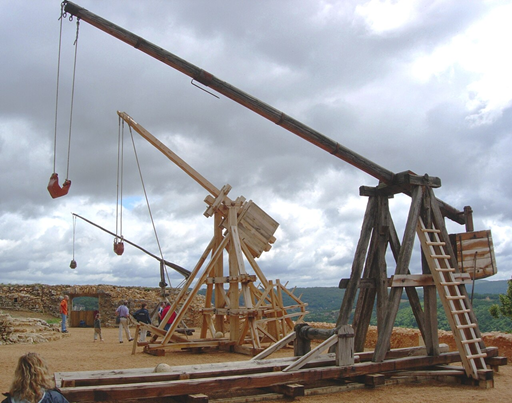
Trebuchet siege engine. Credit: Luc Viatour / CC BY-SA 3.0
Key components include:
Arm: A beam that pivots around a fulcrum (axle)
Counterweight: A heavy mass attached to the short end of the arm
Sling: A flexible cord attached to the long end of the arm that holds the projectile
Projectile: The object being launched
Frame: The supporting structure (not modeled in simulations)
Supported Trebuchet Types
pytrebuchet supports two main trebuchet configurations:
Hinged Counterweight Trebuchet
The traditional design (pictured above) featuring a counterweight that hangs from the short end of the throwing arm via a pivot point (and a sling, often). The projectile typically rests on the ground or in a trough before launch.
Whipper Trebuchet
A special variant where the counterweight hanger is positioned at the top of the throwing arm rather than hanging down at its end. This configuration creates a “whipping” motion during launch. The arm is rotated to a near-vertical position before release, allowing the counterweight to fall from above the arm pivot and providing more time for acceleration of the projectile.
Physics
The differential equations governing trebuchet motion were derived using Lagrangian mechanics. The original equations for hinged counterweight trebuchets were developed by E. Constans and A. Constans and published at benchtophybrid.com.
The simulation process consists of two distinct phases:
1. Sling Phase
During this phase, the projectile remains in the sling while the trebuchet arm rotates. The sling phase terminates when the projectile is released (typically when the projectile’s velocity vector reaches the desired launch angle).
2. Ballistic Phase
After release, the projectile follows a ballistic trajectory influenced by:
Gravitational acceleration
Aerodynamic drag (modeled using Reynolds number-dependent drag coefficients)
Initial velocity and launch angle from the sling phase
The ballistic phase ends when the projectile impacts the ground.
Key Features
pytrebuchet provides a comprehensive set of features for trebuchet analysis:
Multiple trebuchet types: Support for both hinged counterweight and whipper configurations
Realistic physics: Lagrangian mechanics-based equations of motion
Aerodynamic modeling: Reynolds number-dependent drag coefficients using the Clift-Grace-Weber correlation, assuming spherical projectiles
Environmental factors: Configurable air density, temperature, and gravitational acceleration
Customizable parameters: Full control over arm dimensions, masses, inertias, sling properties, and more
Trajectory visualization: Built-in plotting capabilities for position, velocity, and energy
Validated results: The prediction of the projectile’s trajectory by pytrebuchet of a hinged counterweight trebuchet has been verified by comparing it to the prediction made by https://virtualtrebuchet.com/ for the same input parameters.